
Whether you want to install shutters on uPVC frames without drilling or compare a clip-in system with a fixed installation, the sections below cover measurement, compatibility, and the right approach for your property type.
Why perfect fit shutters are ideal to fit shutters without drilling
Instead of fixing into the wall or window frame, the system gives you a neat, tailored finish that sits close to the glass without leaving permanent damage.

How perfect fit shutters clip into uPVC window frames
That cleaner approach starts with the fitting method. Perfect fit shutters clip directly into place using discreet brackets that slide between the window frame and the window beading: no screws, no nails, and no drilling into the frame.
From there, the shutter frame clicks onto the clips and sits flush against the glass. Because the shutters clip to the window itself, they move with the sash when you open or close it, which makes them especially useful on tilt-and-turn windows and similar modern units.
Once fitted, the system is designed to stay stable without sagging or rattling. The close fit can also add a little extra insulation around the edge of the frame, while the 63mm shutter slats give you precise control over light and privacy.
Compatibility checks before you install shutters in UK homes
That clip-in convenience depends on the right window type. Perfect fit is made for uPVC windows and doors, conservatories, patio doors, and many tilt-and-turn windows with compressible rubber beading, but not for timber or aluminium frames without the right gasket detail.
- Frame type: uPVC windows and doors with rubber seals are required; timber and aluminium frames are not compatible with perfect fit brackets.
- Bead depth: The window beading should measure between 18–30mm; place a bank card at the corner, then measure to the glass.
- Minimum clearance: Allow at least 23mm around the frame, with the fitted unit projecting up to 87mm at its deepest point.
- Window alignment: Take diagonal measurements corner to corner, as even a few millimetres out can affect how the shutter frame sits and operates.
Benefits of no-drill shutters for renters and period properties
That window check matters because no-drill shutters let you install shutters without noise, dust, or damage. This is the right choice when your tenancy agreement, lease, or building restrictions rule out drilling.
By contrast, traditional shutters usually need fixed brackets and screw holes. No-drill shutters avoid that entirely, and the difference comes down to reversibility: you can remove them later without marking the surrounding frame.
That same advantage also helps if you move regularly. Many clip-in shutter systems can be taken down and reused on compatible windows.
Step by step shutter installation, measuring and fitting yourself
Accurate measurements are what keep shutter installation straightforward. Get the dimensions right first and the panels clip in without tools; a wrong measurement means a remake and lost lead time.
How to measure windows accurately for perfect fit shutters
You measure from inside the room looking out, taking the glass area rather than the full opening, and the guide on DIY shutter measuring covers the full process in detail: mounting positions, tape placement, and clearance checks.
Once you’ve measured, take readings at three points across both width and height. Use the largest figure each time, because perfect fit shutters are made to your order rather than taken from a standard size.
- Width: Measure at the top, middle, and bottom of the glass area; record all three and use the widest figure.
- Height: Measure at the left, centre, and right; record each one and use the tallest figure.
- Bead depth: Place a bank card at the frame corner and measure the gap to the glass: it must be between 18–30mm for perfect fit compatibility.
- Diagonal check: Measure corner to corner in both directions; the dimensions should match within a couple of millimetres to confirm the window is square.
From there, panes wider than 750mm are manufactured as two equal panels, so the final layout follows your measurements.
Can I install shutters myself on standard UK windows
That depends on the frame. For standard uPVC window shutters with suitable beading, installing shutters is a realistic DIY job: the custom-made panels clip into place without drilling, sealing, or repainting, and Shutters365 explains the full shutter fitting process in the DIY shutter fitting guide.
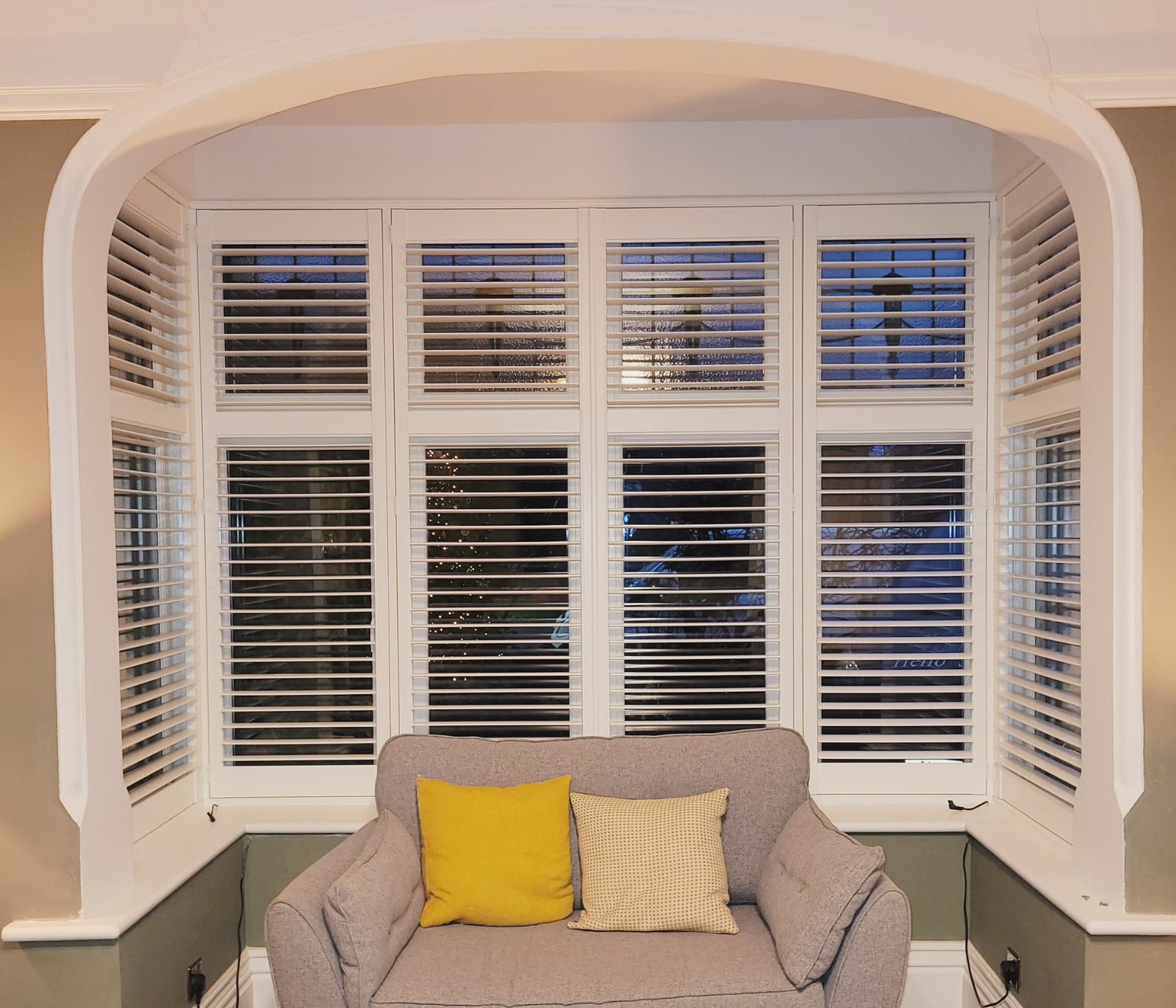
By contrast, bay window shutters, arched openings, and sash windows without the right bead profile need more than online ordering. In practice, those cases call for a surveyor because the extra angles, clearances, or frame details affect both measuring and installation.
| Window type | DIY suitable? | Tools required | Notes |
| Standard uPVC (compatible bead) | Yes | None | Perfect fit clip-in system |
| Tilt-and-turn windows | Yes | None | Full functionality retained |
| Bay window shutters | Surveyor needed | Variable | Additional measurement steps required |
| Timber or aluminium frames | Not compatible | N/A | Perfect fit brackets require uPVC beading |
| Traditional installation (brick/plaster) | Skilled DIY only | Power drill, spirit level | Frame assembly, rawlplugs, hinge pins |
As a result, standard uPVC frames, including tilt-and-turn windows, are usually suitable for DIY. Slow down at the measuring stage, confirm bead-depth compatibility, and then follow the fitting guide step by step.
How Shutters365 helps you fit shutters the easy UK way
Shutters365 keeps the process clear with free guides, pre-production checks, and practical instructions that make shutter installation accessible whether you are experienced with DIY shutters or not.
Made-to-measure no-drill shutters direct from the factory
That support starts with accuracy. Shutters365 produces no-drill shutters to your exact dimensions, then checks each order before manufacturing begins, which cuts down the risk of sizing mistakes before your window shutters are made.
From there, installation is simpler: each set arrives ready to clip in, with no trimming required on site. For many homes, that is the right choice when you want window shutters installed neatly without bringing in a tradesperson.
- Factory-direct pricing: Made-to-measure PVC shutters start from £127/m², up to 40% below major UK brands, with no middleman markup.
- Style options: Full Height, Tier-on-Tier, and Café Style designs cover most window types and room requirements.
- Waterproof materials: High-density PVC will not peel, warp, or yellow, making it suitable for kitchens, bathrooms, and conservatories without special maintenance.
Once you have placed the order, manufacturing and delivery take around 12 weeks from confirmation.
Free guides and support to complete shutter installation UK
That same emphasis on accuracy carries through to fitting. Shutters365 provides a detailed no-drill shutters resource and a shutter fitting guide covering bracket placement, panel hanging, and louvre adjustment, so you can follow each stage of the installation without guesswork.
Free colour samples are available in Brilliant White and Classic White. Once you’ve measured, checked your finish, and confirmed the dimensions, it becomes much easier to fit shutters that look considered rather than improvised.
Support is available by email, and payments are processed securely through Stripe: Visa, Mastercard, Amex, and PayPal are all accepted. Shutters365 Ltd is registered in England and Wales (Co. No. 16654353) and based in Bury St Edmunds, Suffolk.
The clip-in design keeps the installation practical and fully reversible, with no permanent fixings required.
Frequently asked questions
Can you fit window shutters yourself without professional help?
Yes, if your uPVC windows are compatible. Perfect Fit shutters use a shutter-clip system that sits within the window beading, so shutter fitting does not involve drilling, carpentry, or specialist tools.
Once you have finished measuring, your custom-made window shutters arrive pre-assembled, straight from the box. The Shutters365 shutter fitting guide walks through each stage in sequence: from taking your first measurements to locking the clips into the beading.
Because the system relies on the beading, unusual shapes need more care: bay, arched, or other non-standard windows are better checked with a professional survey before you order. That helps confirm the right dimensions and avoids problems with clip placement.
What is the difference between perfect fit shutters and traditional shutters?
Traditional shutters are fixed in place with brackets, screws, and a frame attached to the wall or window surround, which usually means power tools and a more involved shutter fitting process.
By contrast, Perfect Fit works differently. The brackets and shutter-clip system slide between the uPVC frame and the rubber window beading, so the shutters clip into place without drilling.
As a result, Perfect Fit shutters are removable and fully reversible. Perfect Fit is the right choice when you want neat, non-permanent window shutters in a rented home or a property where you do not want to mark the frames.
How do I measure for perfect fit shutters accurately?
Because the system sits within the beading, measuring is straightforward once you know the method. Measure the visible glass area from inside the window, then take width and height readings at three points each: top, middle, and bottom for width, and left, centre, and right for height.
From there, use the largest figure in each set when recording your dimensions. This is worth knowing before you order: bead depth must be between 18mm and 30mm for Perfect Fit window shutters, and diagonal checks help confirm the window is square.
Once you have measured those points, the final check is clearance. The Shutters365 guide covers the full measuring process in detail, including hardware clearances before you place the order.